As European defense strategists closely analyze the logistical reality of high-intensity conflict on NATO’s eastern flank, Germany’s defense sector is shifting focus toward large-scale medical evacuation systems. Planning scenarios for a potential major conflict estimate casualty rates reaching up to 1,000 wounded, injured, or sick military personnel per day. To manage this potential volume, industrial partners and military planners are adapting evacuation models developed during the full-scale war in Ukraine, relying on heavy rail infrastructure to transport patients safely behind frontlines.
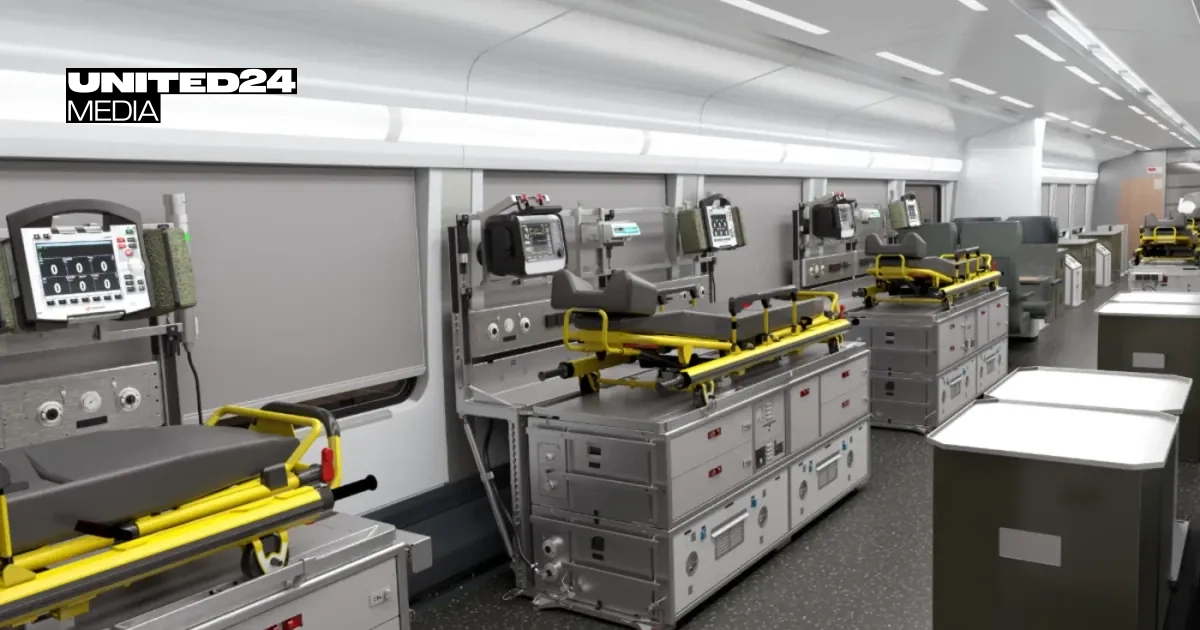
Siemens Mobility and Lufthansa Technik Defense recently signed a memorandum of understanding to develop a rail-based medical evacuation system tailored for the German armed forces and NATO allies. The proposed train concept is designed to accommodate over 150 patients—including those requiring intensive care—alongside up to 90 medical and support staff. By combining Siemens Vectouro passenger coaches with dual-mode Vectron X locomotives capable of running on both electricity and diesel, the trains can operate across borders and continue moving even if regional electrical grids suffer targeted strikes or blackouts.
To ensure seamless medical transitions, Lufthansa Technik Defense is integrating medical hardware currently utilized aboard military transport aircraft, such as the Airbus A400M. Standardized equipment modules allow patients to be transferred between fixed-wing aircraft and rail carriages without leaving their specialized beds, simplifying complex, long-distance medical logistics. Between active deployments, the passenger coaches could be configured back for standard civilian rail operations.
Learning from Ukraine’s Rail Network
The pivot toward railway-based evacuation reflects hard-learned operational realities in Eastern Europe. Air evacuations, which served as the primary medical transport model during modern low-intensity conflicts, become severely constrained when operating in heavily contested airspace with active anti-aircraft coverage. In Ukraine, nearly two-thirds of wounded personnel are evacuated by rail, with roughly one-third moved by road, while medical aviation plays a minimal role near active sectors.
Since 2022, Ukrainian national rail operators converted dozens of standard passenger cars into mobile medical centers, featuring dedicated intensive care units and life-support systems. German defense officials are assessing multiple industrial approaches to match this capability. Beyond the Siemens-Lufthansa design, defense contractor Rheinmetall and train manufacturer Alstom have presented a modular concept utilizing specialized medical containers mounted directly onto heavy railway flatcars. Previously, authorities had also explored retrofitting high-speed ICE 3neo trains into emergency evacuation platforms capable of carrying roughly 30 intensive care patients each.
Logistics, Infrastructure, and Operational Challenges
While industrial concepts demonstrate technical feasibility, experts point out that cross-border logistics across Europe present significant structural hurdles. Transporting hundreds of critically ill patients across international boundaries requires navigating varying track gauges, signaling protocols, and electrical systems. While major European transit corridors offer standardized routing, secondary or rural branch lines—crucial during periods when main lines are congested with heavy military freight—frequently rely on older local infrastructure.
Emergency management specialists note that coordinating irregular emergency rail movements across sovereign borders on short notice remains a complex administrative and technical bottleneck. Deploying mobile hospital platforms effectively will depend heavily on upgrading physical infrastructure, harmonizing international rail standards, and improving the resilience of energy networks supporting regional transportation hubs.
Beyond technical hurdles, the sheer scale of modern warfare has forced a fundamental recalculation across European defense planning. As one observer noted regarding the shift in military expectations:
"The amount of ammo used and casualties is far higher than anyone ever predicted. Conventional thinking was that war would be fast, hard and quick. If we won or lost it'd be over in days. And that's just turned out to not be true."
German intelligence officials have consistently warned of expanding hybrid operations, sabotage, and strategic threats targeting infrastructure across Western Europe. As planning assumptions evolve, developing robust, high-capacity medical transport systems remains a core component of Western deterrence and long-term civil resilience strategy.

